
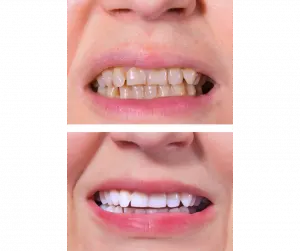
KöR Whitening, Explained
KöR Whitening (also called KöR Deep Bleaching) is a professional teeth whitening system designed to address stubborn, internal discoloration that standard whitening systems sometimes cannot lighten effectively. It combines at-home trays with custom fabrication, chemistry that reactivates whitening agents at higher temperatures, and multiple treatment phases to penetrate deep into the tooth structure. For patients with severe discoloration from tetracycline, fluorosis, trauma, or age-related darkening, KöR often achieves results when other systems have failed.
How KöR Whitening Works Differently
Standard whitening systems use hydrogen peroxide or carbamide peroxide as the active bleaching agent. These work well for surface-level staining and moderate discoloration. However, they're less effective at penetrating deeply into the structure of the tooth to address internal discoloration.
KöR uses a proprietary whitening gel formulation and, critically, a heat activation process during the in-office phase. The heat increases the penetration and efficacy of the whitening agent, allowing it to reach deeper into the tooth structure where internal discoloration is located. This combination of chemistry and temperature makes KöR particularly effective for severe or stubborn discoloration.
Additionally, KöR whitening trays are custom-fabricated (not over-the-counter), allowing complete coverage of the tooth and zero leakage. The custom fit is important because leakage allows saliva to dilute the whitening agent, reducing its effectiveness.
The KöR Whitening Protocol
KöR whitening typically involves several phases:
- Pre-treatment assessment and desensitization. Your dentist evaluates your current shade and discusses realistic goals. If you have sensitive teeth, desensitization may be recommended before whitening begins.
- Custom tray fabrication. Molds are taken and sent to the lab for fabrication of custom trays that fit your teeth precisely.
- At-home phase (5 to 14 days). You wear the custom trays with KöR gel for extended periods (often overnight) over several days. This extended wearing time is one reason KöR is effective for stubborn stains.
- In-office heat activation (one to three visits). During in-office appointments, the whitening agent is reactivated with heat. The heat increases efficacy and helps the agent penetrate more deeply.
- Final at-home phase (optional). After the in-office phase, you may continue with at-home trays to maximize results.
The entire process typically takes two to four weeks. This is longer than standard in-office whitening, which can be completed in one appointment, but the extended protocol is necessary to address deep discoloration.
What Discoloration Does KöR Address Well?
Tetracycline staining. Tetracycline is an antibiotic that was commonly prescribed decades ago for infections. When taken during tooth development (childhood and early adolescence), it can bind to the developing tooth structure and cause gray-brown staining that's very resistant to standard bleaching. KöR is specifically effective for tetracycline staining.
Fluorosis. Excess fluoride intake during childhood can cause white spots or streaking on the teeth (dental fluorosis). Standard whitening often doesn't address this well. KöR can lighten fluorotic teeth, though white spots may remain visible.
Internal discoloration from trauma. A tooth that's been traumatized or has had a root canal can develop internal discoloration over time as the nerve tissue breaks down and releases pigments. This internal staining is difficult to address with standard whitening but often responds well to KöR.
Age-related darkening. As teeth age, the dentin underneath the enamel naturally darkens. The enamel also thins slightly, allowing the darker dentin to show through. This age-related darkening is often stubborn and requires KöR-level treatment.
What Discoloration Does KöR Not Address
External staining from coffee, tea, wine, or smoking responds to standard whitening or even professional cleaning. You don't need KöR for external stains.
Discoloration caused by significant restorations (composite bonding, veneers, crowns) cannot be whitened because restorations don't respond to bleaching. If you want to lighten heavily restored teeth, the restorations must be replaced with lighter-shade restorations, which is more involved and costly than whitening.
Severe gray or brown discoloration that's very deep in the dentin and not accessible even by KöR sometimes requires veneers or crowns as the only effective option. Your dentist will assess whether whitening can help or whether restoration is a better approach.
Sensitivity During and After KöR Whitening
Tooth sensitivity is common during professional whitening, including KöR. The whitening agent can irritate the tooth nerve, causing temporary sensitivity to temperature, air, and touch. The longer wearing time of KöR (at-home trays worn overnight for multiple days) means some patients experience more sensitivity than with one-time in-office whitening.
To manage sensitivity during KöR:
- Use a sensitivity toothpaste for two weeks before starting whitening.
- Ask your dentist about desensitizing gel or varnish to apply before whitening.
- Take over-the-counter pain relief if sensitivity becomes uncomfortable.
- Reduce the duration of at-home wear if sensitivity is severe (wear for 6 hours instead of 8 hours, for example).
- Stay hydrated during the whitening process; dehydration can increase sensitivity.
Most sensitivity resolves within a few days to a week after whitening is complete. If sensitivity persists longer than a week or is severe, contact your dentist.
Cost and Time Investment
KöR whitening typically costs more than standard in-office whitening but far less than veneers or a full set of bonding. The exact cost depends on your geographic location and whether multiple in-office sessions are needed.
The time investment is significant. The protocol takes two to four weeks, and you're wearing trays regularly during that time. You can still eat, drink, and function normally, but the extended timeline is worth noting if you have a time-sensitive event.
Comparing KöR to Other Whitening Options
For mild to moderate discoloration from coffee, tea, or smoking, professional standard whitening or even at-home whitening kits can be effective and cost less.
For severe, stubborn discoloration (tetracycline, fluorosis, internal darkening), KöR is often the best whitening option. If KöR doesn't achieve adequate results, veneers or bonding may be the next step.
For patients with very sensitive teeth, KöR's extended protocol means more exposure to whitening agents, which can increase sensitivity compared to a single in-office session. In some cases, standard whitening with good sensitivity management might be more comfortable.
Results and Longevity
KöR whitening can achieve dramatic results in patients with severe discoloration, sometimes lightening teeth multiple shades. Results are typically visible after the first week and continue to improve over the full protocol.
However, discoloration can return. Tetracycline staining and fluorosis don't recur (the discoloration was already present), but continued staining from diet and habits can accumulate again. Many patients maintain results with periodic touch-ups (standard whitening or at-home maintenance) every six to 12 months.
When to Consider KöR vs. Restorations
If your discoloration is severe and KöR doesn't achieve the result you want, veneers or bonding offer an alternative. Veneers completely cover the discolored tooth with porcelain and are permanent. Bonding is reversible but stains over time.
Before committing to veneers for severe discoloration, try KöR if you're a candidate. Whitening is reversible and less invasive than veneers. If whitening achieves an acceptable result, you've solved the problem without tooth preparation. If it doesn't, veneers remain an option.
The Bottom Line
KöR Deep Bleaching is a professional whitening system specifically designed for severe, stubborn discoloration that standard whitening systems struggle to address. It's highly effective for tetracycline staining, fluorosis, internal discoloration from trauma, and age-related darkening. The protocol is longer than standard whitening (two to four weeks) and can be associated with tooth sensitivity, but for patients with stubborn discoloration, the results justify the time and sensitivity management. If you have severe staining and have been discouraged by failed whitening attempts, KöR might be the solution you've been looking for.
Struggling with stubborn tooth discoloration? Schedule a whitening consultation with Dr. Mercado to see if KöR is right for you, or call (916) 448-5458.
Medical disclaimer: This article is for general educational purposes only and is not a substitute for professional dental or medical advice, diagnosis, or treatment. Individual results vary, and no specific outcome is implied or guaranteed. Always consult Dr. Mercado or another qualified healthcare provider about your specific situation. If you are experiencing a dental or medical emergency, call our office or 911.