
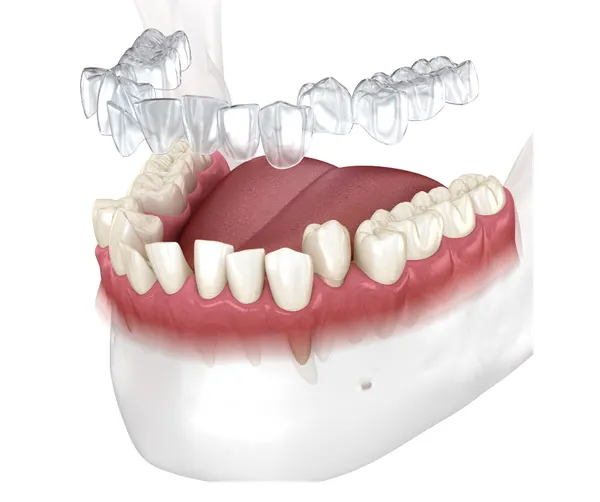
When Orthodontics Comes Before Veneers
One of the most common questions in cosmetic dentistry is about sequencing: if I want both straight teeth and beautiful porcelain veneers, should I do Invisalign first? The answer isn't always yes, but often it is. The decision depends on your starting point, your aesthetic goals, and your budget. There's no universal rule, but there are some clear patterns that emerge once you understand what each treatment accomplishes and how they interact.
Why Straight Teeth Matter Before Veneers
Veneers are thin layers of porcelain bonded to the front surface of your teeth. They can change color, shape, and size. They cannot change tooth position. If your teeth are misaligned, crowded, or rotated, a veneer can only restore the front surface; it can't fix the underlying position.
Consider a common scenario: your upper front teeth are crowded and slightly overlapped. You can place veneers on all six front teeth and they will be whiter and more uniform, but they will still be crowded because the position hasn't changed. The veneers will sit at different angles if the underlying teeth are misaligned. Your smile will look better, but not ideal.
Now consider the same patient after Invisalign: those same six teeth are now properly aligned with even contact. A veneer on each one creates a smile that's not only whiter but also properly proportioned and arranged. The veneers sit at consistent angles and blend seamlessly with your natural tooth positions. The result is significantly more refined.
The Alignment-First Advantage
When Dr. Mercado designs a smile makeover that includes both orthodontics and veneers, the sequence is typically alignment first, veneers second. This ensures that veneers are placed on teeth that are already in their final positions. The veneer design takes advantage of proper tooth alignment to create better proportions, more natural contact points, and a more symmetrical smile.
When Invisalign First Absolutely Makes Sense
Some scenarios strongly favor doing Invisalign before veneers.
Moderate to Severe Crowding
If your teeth are significantly crowded, overlapping, or rotated, Invisalign should come first. Veneers on crowded teeth are expensive (you might need 6, 8, or even 10 of them to create a coherent smile), and the result still looks compromised because the underlying alignment is poor. Straighten first; it reduces the number of teeth needing veneers and dramatically improves the outcome.
Vertical Bite Problems
If your teeth have a steep vertical dimension, a deep bite, or significant vertical discrepancies, Invisalign can often improve these issues. Veneers are purely cosmetic; they won't change your vertical dimension or bite. Correcting these problems first makes the smile look more natural and ensures your veneers sit at the right vertical position.
Severe Rotations
A tooth that's rotated 20 or 30 degrees will show that rotation even with a veneer. The veneer can adjust the visible surface, but the tooth's position relative to its neighbors is still rotated. Invisalign aligns it first; veneers then enhance the appearance of an already well-positioned tooth.
When You Can Skip Invisalign and Go Straight to Veneers
In some cases, veneers alone are sufficient without prior orthodontics.
Mild Crowding or Minor Position Issues
If your crowding is subtle, affecting perhaps one or two teeth, and you're planning veneers on a larger section of your smile anyway, the veneer treatment can often incorporate adjustment to address mild position discrepancies. A veneer can be slightly wider or positioned differently on the tooth to create the appearance of better alignment without orthodontics.
This only works if the underlying position difference is truly minor. If the rotations are pronounced or if the spacing issues are significant, attempting to correct them with veneers alone will result in overly wide, artificially shaped teeth that look compromised.
Patients Who Decline Orthodontics
Some patients know they want veneers but are unwilling to undergo a year or more of Invisalign treatment. If this is your situation, veneers alone can still produce a significant improvement. You won't achieve the ideal result, but you will gain color correction, shape refinement, and an improved smile. The decision is ultimately yours, and Dr. Mercado will discuss what's realistic with and without orthodontic preparation.
Minimal Alignment Issues
If your teeth are already reasonably well-aligned and your primary concern is color, shape, or minor size adjustments, veneers alone are appropriate. Invisalign would be unnecessary treatment, and the sequencing question becomes moot.
The Reverse Sequence: Veneers First, Then Invisalign
This sequence rarely makes sense and is generally not recommended. Here's why:
If you place veneers on teeth that aren't yet in their final positions, two problems emerge. First, when Invisalign moves those teeth during subsequent treatment, the veneers might not align properly with your bite or with adjacent teeth. The veneers were designed and bonded to teeth in their pre-alignment positions; moving the teeth afterward can create occlusal issues or aesthetic misalignment.
Second, the cost is inefficient. You're paying for veneers on misaligned teeth when you could have paid for Invisalign first, then veneers on aligned teeth, resulting in a better outcome at no greater overall cost.
The only scenario where veneers before Invisalign might occur is if a patient insists on cosmetic improvement immediately, but even then, Dr. Mercado would typically recommend a scaled-back veneer plan with the understanding that alignment will happen afterward, or deferring both treatments until they can be done in the proper sequence.
The Timing and Cost Considerations
Doing Invisalign first adds 12 to 18 months to your overall timeline if you're also planning veneers. This requires patience and planning. Some patients are willing to wait; others want results immediately and choose veneers alone despite knowing a better result is possible with prior alignment.
Cost-wise, there's an argument that Invisalign first actually saves money. A severely crowded case requiring eight veneers will cost more than the same patient doing Invisalign (which might allow them to place veneers on just four or six teeth) followed by veneers. The alignment-first sequence often reduces the number of teeth requiring veneer treatment, offsetting the additional cost of Invisalign.
Your insurance coverage varies by plan. Some plans cover a portion of Invisalign but not veneers. Others cover neither. Understanding your coverage before committing to a sequence is important for budgeting.
What Happens After Veneers Are Bonded
Once veneers are in place, your teeth are fixed. They can't be moved with Invisalign. If you realize later that you want to adjust alignment, you're limited to braces or accepting your current tooth positions. This is yet another reason to address alignment first: you avoid being locked into a compromise solution.
However, your veneers don't prevent you from ever wearing a retainer after prior Invisalign treatment. If you did Invisalign, got veneers, and are now wearing a night retainer to maintain alignment, the retainer is compatible with veneers. The veneer surface is smooth and won't be damaged by normal retainer wear.
The Consultation Conversation
The right decision for you depends on your specific alignment issues, aesthetic goals, timeline, and budget. Dr. Mercado will discuss all of these during a consultation, often using digital smile design and treatment simulation to show you the expected outcome of various sequences.
If your teeth are significantly misaligned, expect the recommendation to include Invisalign before veneers. If your alignment is minor, veneers alone might be sufficient. If you're unsure, a comprehensive consultation including a detailed assessment of your bite, alignment, and cosmetic concerns will guide the recommendation.
The Bottom Line
The general rule is this: if your primary concern is alignment, and you also want cosmetic enhancement, do Invisalign first. If your teeth are already well-aligned and your primary concern is color or shape, veneers alone are appropriate. If you're uncertain, a consultation will clarify your specific situation and what sequence makes sense for you. The investment in getting the order right pays dividends in the final aesthetic result.
Considering Invisalign or veneers in Sacramento? Reserve a private consultation with Dr. Mercado, or call (916) 448-5458.
Medical disclaimer: This article is for general educational purposes only and is not a substitute for professional dental or medical advice, diagnosis, or treatment. Individual results vary, and no specific outcome is implied or guaranteed. Always consult Dr. Mercado or another qualified healthcare provider about your specific situation. If you are experiencing a dental or medical emergency, call our office or 911.