
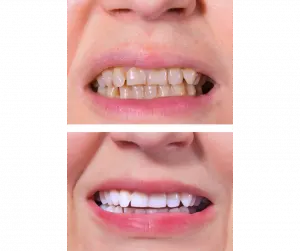
Whitening Tetracycline-Stained Teeth: What's Possible
Tetracycline staining is one of the most challenging discolorations in cosmetic dentistry. Tetracycline is an antibiotic that, when taken during tooth development, can bind to the developing enamel and dentin, causing gray-brown staining that's permanent and very resistant to standard whitening. However, several effective treatment options exist. Understanding what's realistically achievable with whitening, bonding, and veneers helps you choose the right approach for your specific situation and level of discoloration.
How Tetracycline Staining Occurs
Tetracycline was commonly prescribed as a broad-spectrum antibiotic before its discoloring effects on teeth were widely recognized. When the drug is taken during the period of tooth development (roughly birth through age 10, though most pronounced when taken in early childhood), it binds to the mineral structure of the developing tooth.
The staining appears as horizontal bands or streaks of gray, brown, or blue discoloration running across the teeth. The staining is internal, not external like surface staining from coffee or wine. Because it's internal, it cannot be removed by cleaning and is extremely resistant to standard bleaching.
The severity of tetracycline staining varies. Some patients have light staining that's barely noticeable. Others have very dark, obvious staining that significantly affects appearance. The severity depends on the dose of tetracycline, the duration of use, and the stage of tooth development during use.
Standard Whitening and Why It Often Fails
Standard professional whitening (hydrogen peroxide or carbamide peroxide at typical concentrations) is not effective for tetracycline staining. The bleaching agent doesn't penetrate deeply enough into the tooth structure to reach the internal discoloration.
Many patients with tetracycline staining try standard whitening, see minimal results, and become discouraged. If standard whitening hasn't worked for you, the failure isn't due to poor technique or poor product; it's a fundamental limitation of standard bleaching chemistry for this specific type of staining.
KöR Whitening and Tetracycline Stains
KöR Deep Bleaching was specifically developed to address severe, internal discoloration including tetracycline staining. The system uses a proprietary whitening gel, custom-fitted trays, and heat activation to penetrate deeply into the tooth structure and lighten internal discoloration.
KöR can often achieve significant lightening of tetracycline stains, sometimes lightening them two to four shades or more. However, KöR doesn't always achieve complete removal of the stain. Depending on severity, the stain may be lightened but still visible. The result depends on how deeply the stain penetrates and how much of the stain can be chemically lightened.
KöR takes two to four weeks of treatment and can be associated with tooth sensitivity. Its cost varies with location. But for many patients, the achievement of even partial lightening of severe tetracycline staining is worth the time and cost.
Evaluating Your Results with KöR: Realistic Expectations
Before starting KöR, ask your dentist for an honest assessment of what's achievable for your specific stains. Very light tetracycline staining often lightens significantly and may become barely noticeable. Moderate staining may lighten two to three shades and become much less obvious. Very severe staining may lighten but remain visible, though noticeably lighter than before.
Some practitioners suggest doing a trial whitening first: standard whitening for a week or two to see if it achieves adequate lightening. If not, you then proceed to KöR. This trial approach adds time and cost but gives you information about whether further treatment is warranted before committing to the full KöR protocol.
When Veneers Are the Better Choice
If tetracycline staining is very severe, if you want reliable, predictable coverage of the stain, or if KöR doesn't achieve satisfactory results, veneers are the next option. Veneers cover the stained tooth with porcelain and provide precise control over the final color. Veneers are a long-lasting option and don't require ongoing whitening maintenance.
However, veneers require tooth preparation and are a larger commitment than whitening. They cost significantly more per tooth and should be considered if whitening is insufficient.
Composite Bonding as a Middle Option
Composite bonding is another option for tetracycline-stained teeth. Bonded composite can be applied to the stained tooth to cover the discoloration with a lighter-colored material. Bonding costs less than veneers per tooth and is reversible.
The limitation of bonding for tetracycline stains is that the composite is porous and will gradually stain itself over five to eight years, requiring touch-ups or replacement. If you have tetracycline staining and use bonding, you're committing to ongoing maintenance, not a permanent solution.
Combined Approaches: Whitening Plus Bonding or Veneers
Some patients achieve the best results with a combined approach. For example:
- Use KöR whitening to lighten the stain as much as possible, then use bonding to cover residual staining. This achieves optimal color with fewer veneers.
- Whiten adjacent natural teeth with standard whitening so the stained teeth blend better with lighter neighbors. This reduces the perception of the stain even if the stain itself isn't completely lightened.
- Place veneers only on the most severely stained teeth while whitening slightly stained teeth. This reduces the number of veneers needed.
Your dentist can help you design a combination approach that achieves your aesthetic goals within your budget and timeline.
The Timeline Consideration
Whitening takes time. If you're dealing with tetracycline staining and want to explore whitening, plan for several weeks. If you have a time-sensitive event (wedding, major presentation), whitening may not be feasible. Bonding or veneers can be completed faster (bonding in one appointment, veneers in two to four weeks).
If you have time and want to try the least invasive option first, KöR whitening is worth attempting. If you need results quickly or if KöR doesn't achieve adequate lightening, bonding or veneers are faster alternatives.
Cost Comparison and Planning
For four front teeth with tetracycline staining:
- KöR whitening: the lowest upfront cost of the three if it works for your stains.
- Composite bonding: a mid-range upfront cost, with touch-ups every 5 to 7 years.
- Porcelain veneers: the highest upfront cost, lasting 15 to 20 years.
KöR is the lowest upfront cost if it works. Veneers have the highest upfront cost but the lowest cost-per-year of benefit over the long term. Bonding is in the middle but requires ongoing maintenance.
The Bottom Line
Tetracycline staining is challenging but treatable. Start with an honest assessment from your dentist about the severity of your stains and what's realistically achievable with KöR whitening. If KöR can lighten the stains adequately, it's the best option because it's reversible and least invasive. If whitening doesn't achieve satisfactory results, composite bonding or porcelain veneers provide longer-lasting solutions. With multiple options available, tetracycline staining doesn't have to be a lasting source of aesthetic concern.
Dealing with tetracycline staining? Schedule a consultation with Dr. Mercado to assess your options, or call (916) 448-5458.
Medical disclaimer: This article is for general educational purposes only and is not a substitute for professional dental or medical advice, diagnosis, or treatment. Individual results vary, and no specific outcome is implied or guaranteed. Always consult Dr. Mercado or another qualified healthcare provider about your specific situation. If you are experiencing a dental or medical emergency, call our office or 911.