
Invisalign vs. Braces vs. Lingual Braces
Adults seeking orthodontic treatment now have three realistic options: Invisalign clear aligners, traditional metal braces, and lingual braces (hidden behind the teeth). Each approach straightens teeth but differs significantly in appearance, comfort, cost, and effectiveness. Understanding the tradeoffs helps you choose the option that best fits your aesthetic preferences, budget, and lifestyle.
Invisalign Clear Aligners
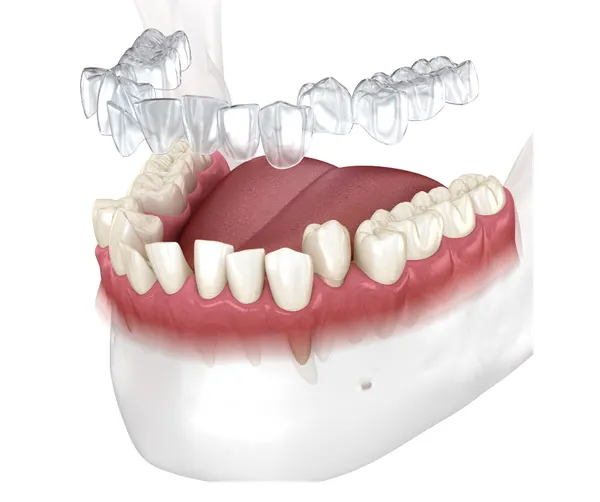
Invisalign uses a series of custom-fabricated clear plastic trays (aligners) that gradually move your teeth. You wear each set for 7 to 10 days before switching to the next set. The aligners are nearly invisible and are removable.
Advantages: Virtually invisible appearance is the major draw. The aligners are removable, so you can eat and drink normally and brush without the aligners in the way. No dietary restrictions. Fewer appointments needed (typically every 4 to 8 weeks). Generally less uncomfortable than braces. Good for patients who prioritize appearance.
Disadvantages: Requires excellent compliance; you must wear them 20 to 22 hours per day for the system to work. Aligner wear can be uncomfortable or cause soreness for the first few days of each new set. Not suitable for very complex bite problems (some severe cases require braces). Can be costly. Aligners can be lost or damaged. Requires careful cleaning of aligners and teeth.
Cost: Generally higher than traditional metal braces but lower than lingual braces, depending on treatment complexity and location.
Timeline: 12 to 18 months for most cases.
Best for: Adults who want invisible braces, have mild to moderate crowding or bite issues, are willing to wear aligners consistently, and prioritize appearance.
Traditional Metal Braces
Traditional braces consist of metal brackets bonded to each tooth and a wire running through the brackets. The wire is tightened periodically to apply pressure and move teeth. Braces have been used for decades and are highly effective.
Advantages: Very effective for complex cases including severe crowding, significant bite problems, and rotation. Require no patient compliance with wearing anything; they're on your teeth constantly. Generally lower cost than Invisalign. Predictable results. Can handle cases that Invisalign cannot. Work faster in some situations because pressure is continuous. No risk of losing or forgetting to wear aligners.
Disadvantages: Obvious appearance; metal brackets and wires are visible. Significant dietary restrictions (no sticky foods, hard foods, etc.). Oral hygiene is more challenging; food gets trapped between brackets and wire. Appointments are more frequent (typically monthly) because the wire needs adjustment. Discomfort is often greater than Invisalign, especially after tightening appointments. Potential for bracket breakage. More emergency visits may be needed.
Cost: Typically the most affordable of the three options, depending on complexity and location. Usually less expensive than Invisalign.
Timeline: 18 to 24 months for most cases. Can be slightly faster than Invisalign in some situations.
Best for: Patients with complex bite problems, severe crowding, or rotation who can't maintain Invisalign compliance. Patients on a tighter budget. Teenagers and young adults who don't mind visible braces.
Lingual Braces (Behind-the-Teeth Braces)
Lingual braces are like traditional braces but are bonded to the back (lingual surface) of your teeth instead of the front. They're hidden from view but are present in your mouth.
Advantages: Completely hidden from view, preserving appearance. Nearly as effective as traditional braces for complex cases. Fixed in place (no compliance issues like Invisalign). Suitable for cases too complex for Invisalign.
Disadvantages: Speech is affected for the first few weeks because the brackets are on the back of your teeth where your tongue naturally rests. This typically improves within a few weeks. Oral hygiene is challenging because the brackets are on the back of teeth and difficult to clean thoroughly. Discomfort can be greater than traditional braces because the brackets are in the way of your tongue. Very expensive (highest cost of the three options). Fewer orthodontists offer them; finding a qualified provider can be difficult. Appointments may be longer and more complicated. Wire and bracket adjustments can be more complex.
Cost: The most expensive of the three options.
Timeline: Similar to traditional braces, 18 to 24 months.
Best for: Patients with complex cases who want to maintain appearance and can afford the premium cost. Adults in high-visibility professions who can't have visible braces. Patients willing to tolerate more discomfort for hidden brackets.
Comparing Effectiveness
Traditional braces and lingual braces are equally effective for all types of orthodontic problems, including very complex cases.
Invisalign is highly effective for mild to moderate problems. It cannot handle some severe cases (very large bite discrepancies, severe rotations, or unusual tooth positioning). Your orthodontist will tell you whether your case is suitable for Invisalign or requires traditional braces.
The Appearance Factor
If appearance is your primary concern, Invisalign is the most obvious choice. Clear aligners are barely visible.
If Invisalign isn't suitable for your case but you want to avoid visible braces, lingual braces are an option, though they come with a significantly higher cost and the speech adjustment issue.
If you decide to use traditional braces, consider tooth-colored ceramic brackets as a compromise. They're less visible than metal brackets but not as invisible as Invisalign.
Compliance and Lifestyle
Invisalign requires excellent compliance. If you forget to wear your aligners or wear them inconsistently, treatment will take much longer or fail.
Traditional and lingual braces require no compliance with wearing anything; they're fixed in place. However, they require dietary modifications and more careful oral hygiene.
If you have a lifestyle that involves frequent eating out, sports that risk bracket damage, or difficulty with consistent daily habits, traditional braces might actually be easier because they don't require you to remember to wear them.
Cost-Benefit Analysis
Invisalign is more expensive than traditional braces but less expensive than lingual braces.
However, if Invisalign doesn't work for your case, you'd need to switch to braces anyway, resulting in higher total cost. Some patients save money by choosing traditional braces upfront if their case is complex.
Additionally, Invisalign sometimes takes longer than braces due to patient compliance issues, resulting in higher true cost per month of treatment.
Choosing Between the Options
Ask yourself these questions:
- How complex is my bite problem? If you have severe crowding or bite problems, ask your orthodontist whether Invisalign can handle it or if braces are necessary.
- How important is appearance to me? If appearance is paramount, Invisalign is the clear winner. If you can tolerate visible braces, traditional braces are more cost-effective.
- How good is my compliance? Be honest about whether you'll wear Invisalign 20+ hours per day. If not, braces are better.
- What's my budget? If budget is tight, traditional braces are usually cheapest.
- What's my timeline? If you need results quickly, braces can sometimes be faster and more predictable.
The Bottom Line
Invisalign is excellent for patients with mild to moderate crowding or bite problems who prioritize appearance and can commit to wearing aligners consistently. Traditional braces are the most versatile, cost-effective option for complex cases and patients who can't maintain Invisalign compliance. Lingual braces are for patients who want the effectiveness of braces with hidden appearance, at a premium cost. Discuss your specific case with an orthodontist or cosmetic dentist qualified in all three options. They can advise which approach is suitable for your situation and what results you can realistically expect.
Ready to explore orthodontic options for adult teeth? Schedule a consultation with Dr. Mercado to discuss Invisalign, braces, and which option fits your goals, or call (916) 448-5458.
Medical disclaimer: This article is for general educational purposes only and is not a substitute for professional dental or medical advice, diagnosis, or treatment. Individual results vary, and no specific outcome is implied or guaranteed. Always consult Dr. Mercado or another qualified healthcare provider about your specific situation. If you are experiencing a dental or medical emergency, call our office or 911.