
Implants vs. Bridges: Practical Comparison
When you lose a tooth, two questions follow: can you afford to replace it, and if so, how? For most patients, the answer involves either a dental implant or a bridge (technically, a fixed partial denture). Both work. Both look natural. But they're fundamentally different solutions with different long-term implications. The choice isn't always obvious, and the best option depends on your specific situation.
How a Bridge Works
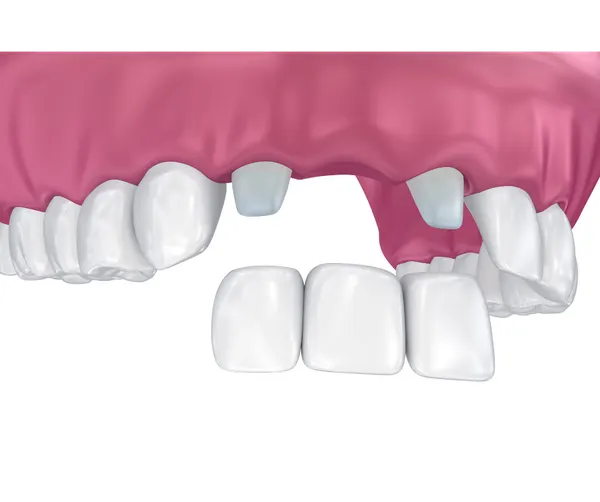
A traditional bridge is a false tooth (or teeth) suspended between two natural teeth or implants. The natural teeth adjacent to the gap are prepared (ground down) to receive crowns. The false tooth sits on top of the bone beneath the gap. The entire assembly is bonded together as a unit.
A simple example: you're missing your upper left first premolar. The tooth in front and the tooth behind are ground down to receive crowns. A three-unit bridge is fabricated: a crown on the tooth in front, a fake tooth in the middle, and a crown on the tooth behind. All three units are bonded as one piece, permanently bonded to your teeth.
Bridges have been used for decades. They work, they look natural, and they're reliable. But they require sacrifice: you must grind down healthy teeth to support the bridge.
How an Implant Works
An implant is a titanium screw surgically placed into your jaw bone where the tooth is missing. Over several months, your bone integrates with the implant. Once integrated, an abutment (a small post) is attached to the implant, and a crown is fabricated on top. The result is functionally and esthetically similar to a bridge, but the missing tooth is replaced independently, without involving the adjacent teeth.
Implants represent a fundamentally different approach: instead of using neighboring teeth for support, you're creating new support through osseointegration.
The Cost Comparison
Upfront, a bridge is usually cheaper. A simple three-unit bridge typically costs less than an implant with a crown, though the implant cost varies with complexity and whether bone grafting is needed. In the short term, a bridge appears to be the economical choice.
However, cost over the lifetime of the restoration tells a different story. A bridge typically lasts 7 to 15 years before it needs replacement or repair. When it fails, it often fails catastrophically: a crown comes off, the underlying tooth decays because the bridge was trapping bacteria, or cement washes out. Replacement might be as expensive as the original.
Implants, with proper care, routinely last 20, 30, or more years. If an implant crown breaks, you're usually replacing just the crown, not the entire restoration. If an implant fails catastrophically, it's unusual. Long-term cost analysis often favors implants despite the higher upfront investment.
Effects on Adjacent Teeth
This is the crucial difference. A bridge requires that the teeth on either side of the gap be ground down and crowned. These teeth were previously healthy. Now they're crowned and dependent on the crown margins for protection. If the crown margins seal imperfectly, bacteria infiltrate and decay develops beneath the crown. If the cement washes out, the same problem occurs.
Studies show that teeth supporting bridges have increased failure rates compared to natural teeth. They're not ruined by supporting a bridge, but they're at higher risk. Some patients who got bridges 15 years ago now find that the teeth supporting the bridge have failed, requiring extraction of those teeth too. This converts a one-tooth problem into a three-tooth problem.
Implants don't affect adjacent teeth. They stand alone. Your neighboring teeth remain unaltered and unaffected by the implant's presence.
Bone Loss and Durability
When you lose a tooth, the bone beneath it begins to resorb (dissolve) because there's no longer a root transmitting chewing forces into it. A bridge sits on top of this resorbing bone; it doesn't prevent the resorption. Years after a bridge is placed, the bone beneath the false tooth has shrunk significantly.
An implant, by contrast, mimics the function of a natural tooth root. Chewing forces are transmitted through the implant into the bone, signaling the bone to maintain its density. Over years, bone around a properly integrated implant remains stable. This is why implants preserve your long-term bone architecture and facial support.
This bone preservation matters cosmetically. Over decades, patients with bridges experience progressive bone loss that can eventually change their facial appearance: lips thin, vertical dimension decreases, a sunken appearance develops. Patients with implants maintain their facial support and appearance.
Maintenance and Care
A bridge requires careful maintenance. Flossing under a bridge is challenging because the false tooth sits on bone, and there's no clear space underneath for floss. Specially designed floss threaders or superfloss (thick floss with a stiff end) must be used to clean beneath the false tooth. Many patients don't floss bridges adequately, allowing plaque to accumulate, leading to decay and eventual bridge failure.
An implant crown is maintained like a natural tooth: brush and floss normally. An interdental brush around the implant is helpful, but standard oral hygiene works fine. Implants require no special flossing technique.
Esthetic Considerations
Both bridges and implants can be made to look natural. However, implants have an esthetic advantage in some situations. If the gap is in the front of the mouth where gum tissue visibility matters, a bridge's false tooth might not have natural-looking gum tissue around it. The gum appearance depends entirely on the bridge design and the technician's skill.
An implant's gum tissue is your own living gum, which naturally looks more authentic than a fabricated gum component on a bridge. If esthetic gum appearance is important, this is an implant advantage.
Longevity and Failure Rates
Bridges have a 10-year success rate of around 80 to 90 percent. This means that around 10 to 20 percent of bridges fail within 10 years. Some of these failures are due to decay under the bridge, others due to crown fracture or cement failure.
Implants have a 10-year success rate of around 90 to 95 percent, higher than bridges. With proper care, implant failure is unusual. Most implant complications can be managed without losing the implant entirely.
The data shows that implants are more reliable long-term, though both have good success rates when executed well and maintained properly.
When a Bridge Is the Better Choice
Despite implants' advantages, bridges are sometimes the better option.
Inadequate Bone
If your bone is severely deficient and bone grafting isn't appropriate, an implant might be impossible. A bridge uses the adjacent teeth for support, regardless of bone volume. In this situation, a bridge is the practical choice.
Multiple Adjacent Teeth Missing
If you're missing three consecutive teeth, a bridge using the teeth on either side for support is more economical than three implants. Multiple implants cost significantly more than a single bridge spanning multiple missing teeth. Budget considerations might favor a bridge.
Poor Implant Candidates
Some patients have health issues, medications, or habits (like smoking) that make implant success less reliable. For these patients, a bridge might be the safer choice despite the risks to adjacent teeth.
Timeline Urgency
A bridge can be completed in two to three weeks. An implant requires 6 to 8 months. If you need a tooth replaced immediately, a bridge is faster.
When an Implant Is the Better Choice
For most single-tooth replacements, an implant is often the stronger long-term choice.
Single Tooth Gap
When you're missing a single tooth and the adjacent teeth are healthy, an implant preserves those teeth and provides better long-term outcomes. The 5 to 7 months wait is worthwhile.
Long-Term Planning
If you're planning to keep all your teeth for life, an implant's long-term reliability and bone preservation make it the better investment. The upfront cost difference is recovered through decades of function without major repair.
Esthetic Priorities
If the gap is visible and esthetic gum appearance matters, an implant's living gum tissue is superior to a bridge's fabricated appearance.
Adjacent Teeth Are Compromised
If the teeth adjacent to the gap already have large restorations or are otherwise compromised, grinding them down to support a bridge compounds the problem. An implant avoids additional damage to already-compromised teeth.
A Hybrid Approach
Some patients benefit from combining both approaches. For example, if you're missing two adjacent teeth, you could place one implant and support a bridge from that implant plus an adjacent natural tooth. This compromises between cost and long-term tooth preservation.
Dr. Mercado will discuss hybrid approaches during your consultation if your specific situation warrants it.
The Bottom Line
Bridges are predictable, time-tested, and sometimes the best option. But implants, for appropriate candidates, offer better long-term outcomes and preserve your adjacent teeth. For a single missing tooth, the choice usually favors an implant. For multiple missing teeth or in cases where implants aren't feasible, a bridge is a legitimate and effective option. Discuss your specific situation with Dr. Mercado; the right choice depends on your anatomy, budget, and long-term goals.
Considering tooth replacement in Sacramento? Reserve a private consultation with Dr. Mercado, or call (916) 448-5458.
Medical disclaimer: This article is for general educational purposes only and is not a substitute for professional dental or medical advice, diagnosis, or treatment. Individual results vary, and no specific outcome is implied or guaranteed. Always consult Dr. Mercado or another qualified healthcare provider about your specific situation. If you are experiencing a dental or medical emergency, call our office or 911.